• Miscellany


    • Playboy’s original letterhead is a modernist classic, a bracing reminder of how important refined aesthetics were to Hefner’s enterprise and his notion of the good life. Via Letters of Note, here… a fascinating site that gathers up letters, postcards, telegrams, faxes, and memos of significance and interest. Hat tip @ettagirl, who’s feed on art & culture is well worth following.


    • Via Invisible Oranges, a classically-trained singer and voice teacher critiques five classic metal singers.

      Regarding Iron Maiden’s Bruce Dickinson: …Nothing but admiration for this singer…His diction is easily intelligible, regardless of range… an intensely rhythmic delivery… without losing legato and musical momentum, something a lot of classical singers struggle with, especially when interpreting the many staccato and accent markings that crowd scores by Bellini, Donizetti, etc.

      Ronnie James Dio? …another very fine singer… so naturally resonant. He performs with perfect legato, clear diction, and a consistent, organic vibrancy. He arranges his resonance space to create a shallow snarl without setting up any resistance for his breath. You can tell how healthy his delivery is from the way he moves in and out of brief moments of harmony with the other tracks with impeccable intonation. The whole piece is a must read… here.


    • Besides the classic, sharp, unfussy design of the cover, the photograph bears an uncanny resemblance to Robert McGinniscelebrated rendering of Audrey Hepburn for the poster of Breakfast at Tiffany’s, below.


    • I really dig the new New York State license plate. I spent the last week driving abound the better part of western NY and these tastefully classic looking beauts kept popping up. I love, in particular, the re-embrace of the state’s official colors. Uncluttered, universal, distinctive yet free of kitsch they’re everything good government design should be. Not perfect (the arc on Empire State is a bit janky) but still, aces.

      (Unfortunately, they need all the support they can get. Quite a kerfuffle has broken out in thier wake. Originally, adoption of the new design was mandatory, accompanied by a fee - folks went bananas. Once the design was introduced, they went double bananas, castigating the design as plain and ugly. Cue kerfuffle. Sigh.)


    • Black Sheep Antiques, Duanesburg, NY


    • Spotted this uncharacteristically swinging cover art for Anthony Powell’s The Military Philosophers - the ninth in the A Dance to the Music of Time series, a twelve novel cavalcade of mid-20th century English life, manners, culture, etc…


    • Short of the actual detection of extraterrestrial life few things would make me happier than the following news. 2010 is the year of “re-contact” with the mighty Man or Astroman! According to a transmission from MOAM-HQ, after 10 years of cryogenic storage they have have knocked the frost particles off and are properly thawed for live music experimentation. Read the rest of the transmission, here. And remember, fear not - they come as friends.


    • “Check out the eye popping, fantastic type and strikingly modern composition of this old Bob Seger record” is not something I could have imagined proclaiming in a million years, but seriously - check out the eye popping, fantastic type and strikingly modern composition of this old Bob Seger record (larger version, here). And, while you’re at it, take a few minutes to soak in this record’s centerpiece - the epic, wistful, road-weary melancholy of “Turn the Page.”


    • Absolutely astonishing ultra-high resolution photographs of birds by Andrew Zuckerman. A decent overview can be found here, while Zuckerman’s site, here, showcases even more. Also check out his earlier project, Creature, featuring a wider spectrum of wildlife. The detail is breathtaking, and the depth of personality projecting from the animals is downright eerie.


    • For your pleasure, an oddly charming, earnest, hippy-dippy photo recreation of Manet’s The Luncheon on the Grass from an old 1970 photography annual.


    • Gorgeous, elegant cover for Richard Avedon’s 1959 portrait book Observations. Rather than taking it in whole, it rewards a close scan so you can follow the way the letters slice, carve and cordon off patches of creamy white. Easy to appreciate, so hard to pull off.


    • A moment’s rest at the Rochester Institute of Technology, between two immense murals by Joseph Albers meant to evoke the equally brilliant Kodak logo. Aces.


    • Things the Ramones did want to do, things the Ramones did not want to do, things the Ramones did do, things the Ramones told you to do, things the Ramones warned you about doing, things the Ramones did not like, things the Ramones wondered about, and things the Ramones would do next time… over at Electra Luxx’s place, here.


    • Goodbye, and a hearty salute to Grafik Magazine, which folded a few days ago. This cover gallery, here, is a fitting testament to its accomplishment - a cavalcade of top notch design, and an ad-hoc primer to just about every style & mode in vogue since 2003.


    • The first trickle
      of water down
      a dry ditch stretches
      like the paw
      of a cat, slightly
      tucked at the front,
      unambiguous
      about auguring
      wet. It may sink
      later but it hasn’t
      yet.
      – Kay Ryan, The Paw of a Cat

  • Further miscellany, odds & sods, etc., at the Tumblr annex, here.
Categories: Art, Books

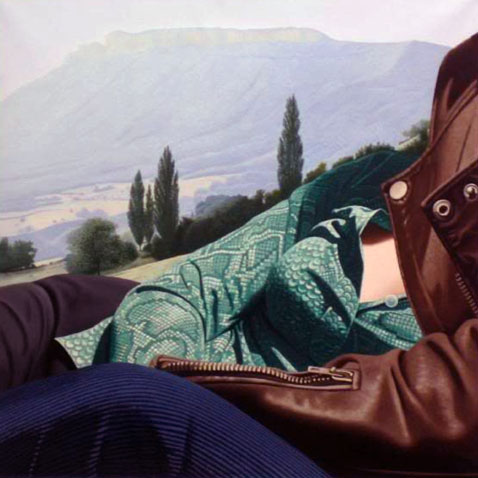
Over the weekend I spotted the new Martin Amis book, The Pregnant Widow. I like Amis a ton, but with Amis you need to feel Amis-y to want to marinate in Amisland, and currently, me, not so much. Anyway, though, I was very taken with the cover art. It was a photo-realistic, yet aggressively cropped painting of a man and women nestled together against the slope of a picturesque valley.

What stuck me was the how powerful both the formal and narrative aspects of the painting were. The composition was riveting – this tightly packed moment given epic scale – and the weight of shared experience slung between the two figures was palpable. From what I know of the book’s plot and themes, which follow the tumultuous vicissitudes of a group of friends spending the summer in a remote Italian castle, it seemed a note-perfect choice – marred only by completely ham handed typesetting and design.

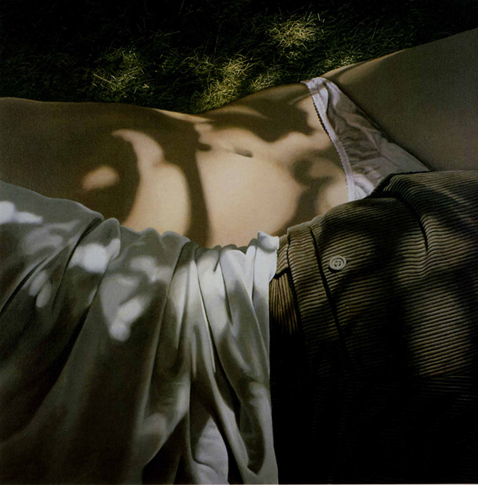
The painting, Il ne se plaignait jamais… (He never complained…), from 1976, is the work of the French painter Gerard Schlosser. Schlosser is most closly associated with the Narrative Figuration movement, a distinctly French mash-up of Pop and Photorealism.

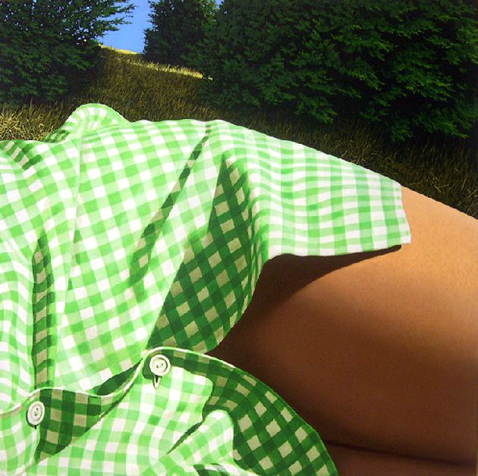
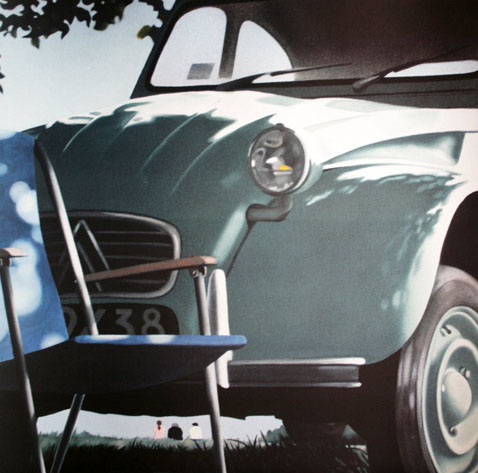
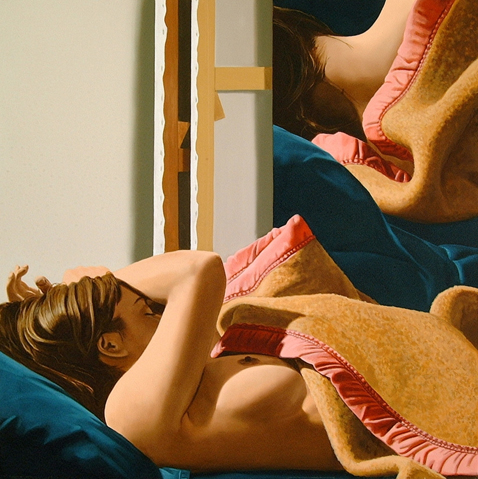
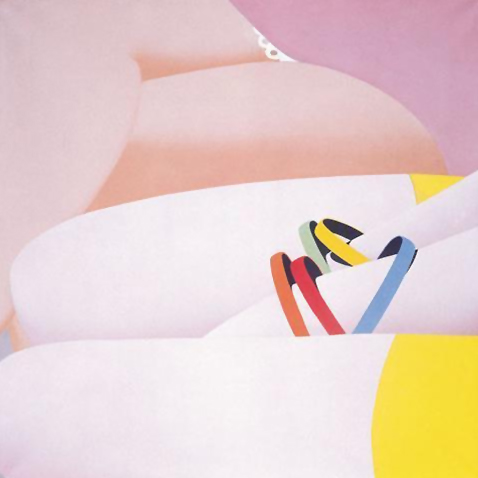
His early work was rooted far more in a sexy cartoon pop aesthetic – like a combination of Guy Peellaert and Tom Wesselmann. As he evolved the work became more overtly photo-realistic, but just as meticulously staged – details are purposefully exaggerated, extraneous objects removed, everything is framed and arranged for as much narrative impact as any comic book panel. One critic described this dynamic perfectly, that for Schlosser, “framing is never a trivial gesture. It tightens the most significant narrative element, the small detail that summarizes the essence of a moment.”

What I love about his paintings is that they transmit on four equally powerful frequencies. They are wonderfully composed realist abstractions. They contain a powerful dose of concentrated storytelling. They celebrate the figure as landscape. And they frame a vantage point that is the very definition of intimacy – conversational, sexual, relational – in a way that is incredibly potent and evocative. They’re artful, moving, brazenly sexy, and, as Blackadder might say, as French as a pair of self removing trousers.

(Schlosser’s work is scattered about the web. Most of the sites are in French. No English monograph seems to exist. There are at least three French ones, a bit pricey and all difficult, it seems, to obtain)